How does it work?
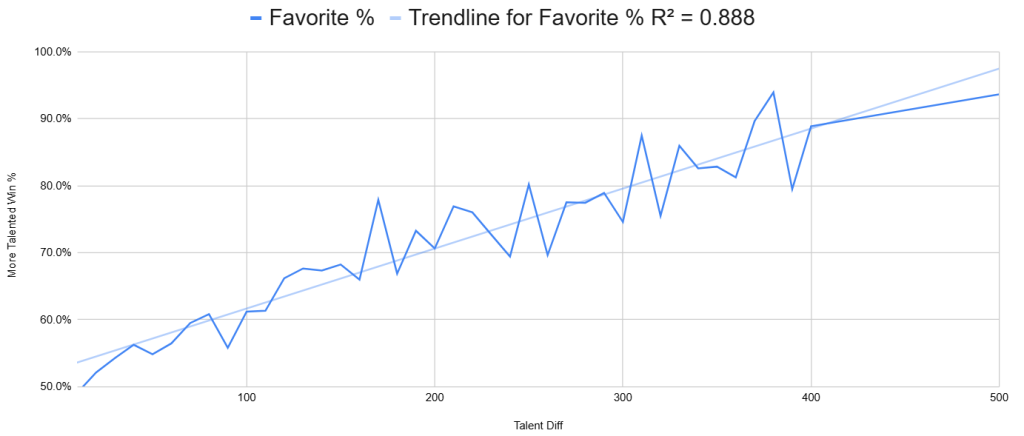
I took every game since 2015 where both teams were fbs and had a composite talent score of at least 100, a sample of about 8,000 games. I graphed talent difference vs. winning percentage (with talent difference grouped into buckets of 0-10 points, 10-20, etc.)
Graph 1 looked like this
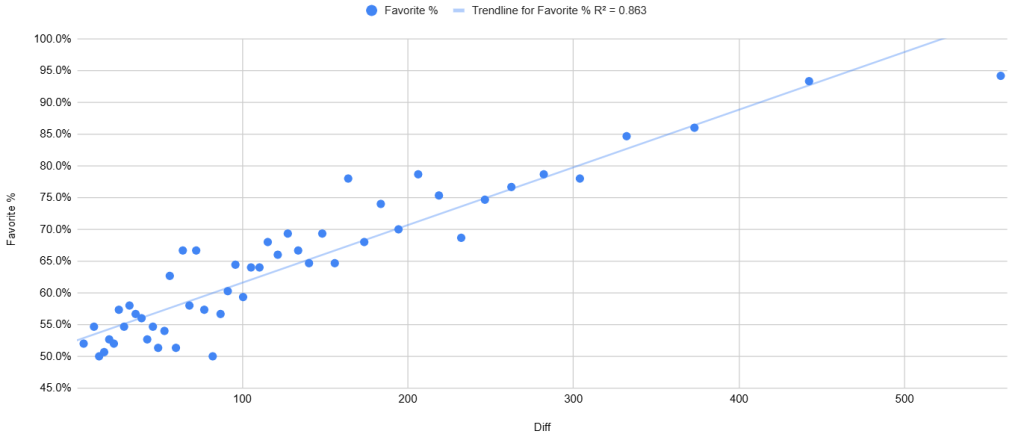
I experimented with equal sized buckets of different size to account for the fact that there are more games between closely talented teams than on the margins. I experimented with different bucket sizes. Here’s Graph 2:
I redid the graph to separate out home teams from away teams, and ended up with Graph 3:
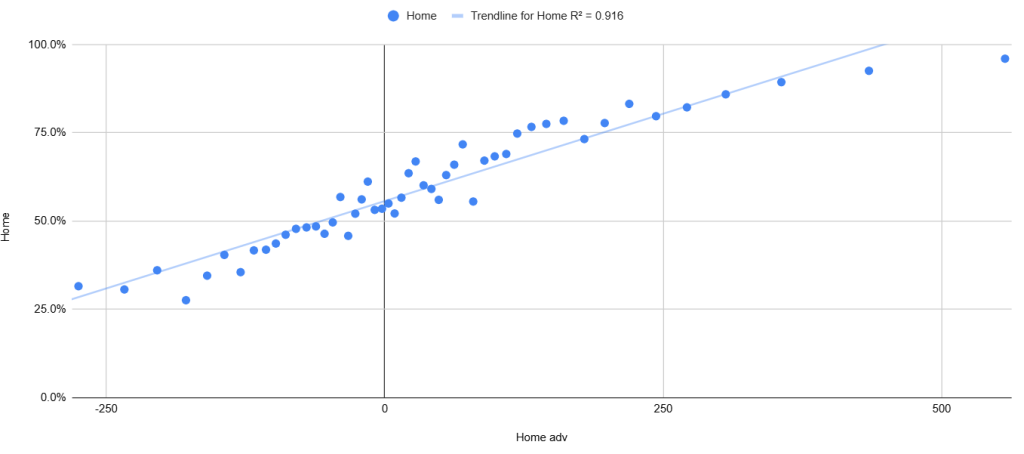
I experimented with different bucket sized and other changes, and, the slope rarely varied by more than 4% in either direction from the final graph (controlled for Home Field advantage). I settled on Graph 3, and used the best fit line of that graph as the equation for calculating the expected win % of each game. For neutral site games, the expected win % is calculated using Graph 2, which includes all games regardless of home and away.
All the work was done in Google Sheets. No AI or coding was used. I’m not a statistician, but I think the basic concept is pretty solid. I’d welcome any feedback on the methodology, but if you identify a problem, please also identify a suggested solution! And use small words. You can reach me on Twitter @WETcfb or email [email protected].
Is WET adjusted for strength of schedule?
Every single WET score is inherently based on strength of schedule, because WET is calculated based on the difference between talent level of the two teams. So there’s no adjustment because it’s a basic part of the formula.
Is WET adjusted for home field advantage?
Again, the WET formula is a best-fit line that separates home and away teams. So there’s no adjustment, it a basic part of the formula. Neutral site games use a different formula which is based on the average winning percentage of all games regardless of home or away team.
Is WET adjusted for actual performance, won-loss, ELO, SP+, etc.
No, and that’s intentional. All of those stats take into account how the team has previously performed. The idea of WET is to isolate, as much as possible, what a coach is doing with their talent. Adjusting for ELO (or those other factors) is saying “Hey Kirk Ferentz, sure you beat a more talented team, but they’re not a good team because they have a crappy coach who has led them to a 3-6 record and a low ELO.” That’s the whole point of what WET is supposed to measure.
Does WET adjust for player injuries?
No, but I’m open to doing that if I could figure out how. 247sports published a composite talent ranking that stays steady throughout the season. They also publish their individual rankings and their formulas for how the individual rankings turn into the composite. But they don’t give their individual rankings in csv format, so I would have to manually enter every player’s ranking, then recreate their formula, and then omit players who were injured. If 247sports wants to give me their rankings in csv, I’m try to tackle it but until then it’s unlikely.
I disagree with your WET ranking of [coach].
Yeah that’s not a question, but I get it. Nobody is more upset than me that Uncle Kirk is number one. WET is intended to be the start of the conversation, not the end of it. I don’t think it’s perfect but I think it’s better than just comparing won-loss records or “this coach is 0-7 against AP Top 5 teams.” I think there are coaches on here who are genuinely over- and undervalued, and I’ll write some posts on who and why. But I’d love your thoughts as well, with evidence.
What led you to create WET?
I’m a Penn State fan. In 2024, after we lost to Ohio State AGAIN, I wanted to answer the question “How many times SHOULD we have beaten Ohio State?” Answer: 3 of 10 times instead of the 1 of 10 times we actually won. That led me to “Is James Franklin a good coach?” Answer: he’s a somewhat WET coach, but not very WET. A damp coach? Then Franklin got fired, and I wanted to know “Which candidates actually have a proven track record of beating more talented teams, which is the thing Franklin could never do?” Answer: Jeff Brohm, Matt Campbell, Eli Drinkwitz.
Does your formula consider coordinators?
No. I have ideas but they’re a long way from fruition.
But don’t coaches also control their talent level through recruiting?
Coaches don’t control their talent level. They can impact it, but a lot less than you would think. I’ll have a post on this soon examining the evidence.
Does the coach really control everything besides talent level?
No. I will explore some other factors that may be at play in future posts.